Almost every AI model — OpenAI, Anthropic, Google — bills by the token, not the word or the request. If you understand tokens, you can predict what a listing will cost before you ever run it.
§ 01 What is a token?
A token is roughly 4 characters of English text — about ¾ of a word. The sentence "Sigrix lists AI building blocks." is about 7 tokens. Models read and write in tokens, and providers bill per million tokens consumed.
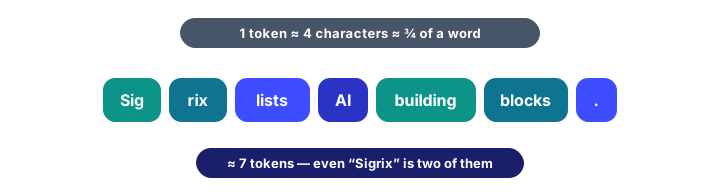
Punctuation, spaces, and rare words split into more tokens; common words are a single token. Code and non-English text are usually denser, so the same character count costs more.
§ 02 Input + output = total cost
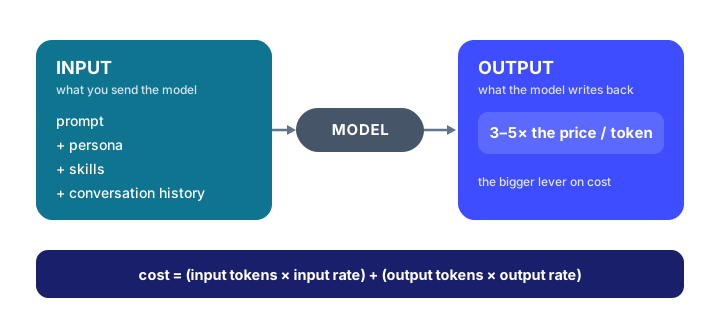
Every run has two sides. Input is what you send the model: the prompt, persona, attached skills, and any conversation history. Output is what the model writes back. Output tokens usually cost 3–5× more than input tokens, so a chatty model can be expensive even on a short prompt.
cost = (input tokens × input rate) + (output tokens × output rate)
That's why a one-line prompt that produces a 2,000-word essay can cost more than a long prompt that returns a single number.
§ 03 Why estimates vary by listing type
Each of the five building blocks sizes differently. The estimate on a listing reflects how that type tends to consume tokens:
| Listing type | Token profile |
|---|---|
| Prompt / Persona | Small input (a few hundred tokens). Output depends entirely on the task. |
| Skill | The SKILL.md file is loaded into context once, then reused at near-zero marginal cost. |
| Assistant | Multi-turn, so input grows with conversation history. Expect 2–5× a single prompt. |
| Agent | Multi-step runs accumulate tokens across each step plus tool calls. Heaviest by an order of magnitude. |
| Product | Bundles all of the above, so the estimate is the sum of its parts. |
§ 04 Where to find the estimate
Open any listing and check the Tokens tab. We show:
- Estimated input tokens per run
- Estimated output tokens per run
- The model the seller tested on
- A sample dollar cost at current provider rates
Estimates are seller-supplied averages. Actual usage depends on your inputs, the model you pick, and how long the conversation runs.
§ 05 Rule of thumb
When you compare two listings, look at the output estimate first — it's the bigger lever on cost. A listing with a large prompt but a tight, structured output is usually cheaper to run than a small prompt that rambles.
And if a listing doesn't show a token estimate yet, treat that as a question to ask the seller, not a reason to assume it's free.
Sigrix product updates, in your inbox.
One email each time a major update to Sigrix goes live, with a link to read it on the Hub. One-click unsubscribe, no noise.
0 Comments
Join the discussion. Be kind and stay on topic.