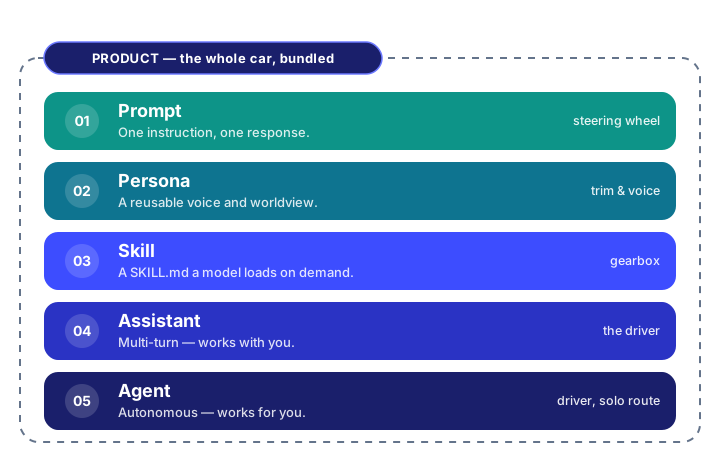
Buying or selling on Sigrix? You'll see five building blocks — and the composed listings that bundle them. They build on each other like the parts of a car: a prompt is the steering wheel, a persona is the trim and the voice, a skill is the gearbox, an assistant is the driver who takes the wheel and works the gearbox, an agent is the same driver running a route on their own — a crew is a dispatcher with a bench of specialists, routing each request to the right one — and a product is the whole car, bundled and ready to drive away.
§ 01 Prompt
A prompt is a single instruction you send to a model. The smallest listing on Sigrix. Useful when you know exactly what you want the model to do and you want the cleanest, cheapest result.
- One instruction, one response.
- Sometimes with a persona attached so the model speaks in a specific voice.
- Cheap to run, easy to compare side-by-side.
§ 02 Persona
A persona is a kind of prompt: the one that sets who the model is, a voice and a worldview it adopts. A persona listing on Sigrix is a reusable system prompt with character, tone, and constraints baked in; you publish one under Prompt, and the marketplace shows it with the prompts.
Think: "the editor of a quarterly magazine, terse and unimpressed" vs. "a customer-success rep at a startup, warm and explicit." Same model, very different output.
§ 03 Skill
A skill is a reference document — a SKILL.md file — that the model can load into context to do a specific job. Skills do not run on their own; they are tools that an assistant or agent picks up when needed.
Sigrix skills follow the open agentskills.io specification, so the same file works in Claude Code, Codex CLI, OpenCode, claude.ai, and the Claude API. A good skill listing on Sigrix bundles the file plus a worked example so the buyer can see what "good" looks like.
§ 04 Assistant
An assistant is multi-turn. It holds a conversation, calls skills when relevant, and works with the user step by step. Most of what people picture when they say "AI" is an assistant: ChatGPT, Claude, a support bot in the corner of a webpage.
An assistant listing on Sigrix is a prompt with up to ten worked examples and, where its seller adds them, a persona for its voice, the skills and MCP servers it calls when asked, and the documents it asks its buyer for. The buyer downloads it ready to install; see how to build and sell an AI assistant.
§ 05 Agent
An agent runs for you, not with you. You tell it the goal and it executes the steps — calls tools, decides what to do next, hands you back a finished result. Less back-and-forth, more autonomy.
Agents are the heaviest building block: more tokens, more time, more risk of going off-track. Sigrix listings show the agent's tested runbook so you can see exactly what it'll do.
The managing entity: Crew
A crew is a composed listing, not a sixth block: a manager persona sitting above a set of task prompts, with routing rules for which task handles which request. You chat with the manager; it classifies your message and answers as the right specialist. Buying a crew grants every building block inside it — the persona and each task prompt land in your library individually.
A crew is not an agent. It is routed and conversational — it works with you, one reply at a time — while an agent runs autonomously and hands back a finished result. On Sigrix the crew is the step above a prompt: the same chat workflow, with more range.
The bundle: Product
A product is not a sixth block either — it's the bundle. It packages a persona, a few skills, an assistant, and maybe an agent into a single listing with one price. Products are the "ready-to-drive" tier — pick one, plug it in, ship.
The five blocks compose: personas and skills feed assistants, personas and prompts compose into crews, and assistants and agents wrap into a product. Pick the layer that matches the job.
Sigrix product updates, in your inbox.
One email each time a major update to Sigrix goes live, with a link to read it on the Hub. One-click unsubscribe, no noise.
0 Comments
Join the discussion. Be kind and stay on topic.